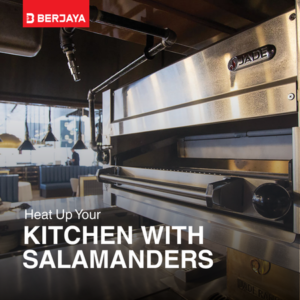
Heat Up Your Kitchen With Salamanders
From dinner to dessert, salamander broilers bring direct, intense heat, plus offer a vertical footprint advantage.
A staple in many commercial kitchens, the salamander broiler is a compact, high-impact piece of equipment—especially valuable for operators who must maximize efficiency while managing rising operational costs. Designed as an overfired broiler, it can be installed above a cooking range or mounted on a wall, allowing kitchens to conserve valuable hood space and make better use of their existing footprint.
As one equipment manufacturer explains, dedicating horizontal hood space can cost between $2,000 and $5,000 per linear foot. By contrast, using vertical space—stacking equipment above existing appliances—adds functionality with little to no additional hood expense.
Salamanders are often mistaken for cheesemelters because of their similar appearance, but the two serve different purposes. A salamander produces extremely high heat and is capable of broiling steaks, burgers, poultry, seafood, vegetables, and more. A cheesemelter, on the other hand, is designed for lower-temperature tasks such as warming plates, toasting buns, and melting cheese. It is not intended for cooking raw foods.
A salamander can perform all the functions of a cheesemelter while also serving as a finishing tool—caramelizing crème brûlée sugar, browning au gratins, glazing proteins, or quickly reheating dishes before service or delivery. However, the reverse is not true: a cheesemelter cannot replace a salamander’s high-heat capabilities.
To determine the right fit for your kitchen, carefully evaluate your menu and production needs. Depending on your operation, a salamander, a cheesemelter, or a combination of both may be the most effective solution.
The salamander is closer to a different piece of equipment: an upright broiler. A salamander offers similar functionality, but is smaller and can be mounted vertically. Analyze your throughput needs before deciding which of these two to specify. For example, a salamander might meet the needs of a pub that offers steaks or burgers among its menu mix, but wouldn’t suffice for a high-volume steakhouse. In some cases, a salamander could even replace a charbroiler, again saving precious space.
Heating Methods Explained
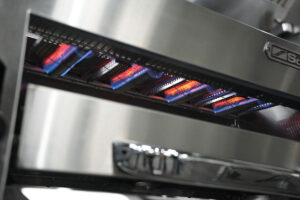
Salamander broilers are offered with two primary heating technologies: infrared and radiant. Infrared salamanders use ceramic heating tiles that emit infrared energy, allowing heat to penetrate food quickly and efficiently. This type of heat is especially effective for broiling flat or evenly sized items such as steaks, pork chops, and similar cuts.
Radiant salamanders, by comparison, operate using open-flame burners. Heat is captured and redirected downward by stainless steel radiants, creating a broader, more surrounding heat pattern. As one manufacturer describes it, radiant heat delivers a more enveloping cooking effect, whereas infrared heat focuses intense energy directly on the food’s surface.
Because of this wider heat coverage, radiant salamanders are particularly well-suited for uneven or irregularly shaped foods, such as half chickens, where consistent browning across varying thicknesses is essential.
Infrared vs. Power Source Options
Infrared salamanders currently dominate the commercial kitchen market due to their speed and performance. These units heat up rapidly—often in as little as 90 seconds—and reach higher operating temperatures, allowing kitchens to reduce ticket times and improve service efficiency. Although infrared salamanders are typically priced higher than radiant models, the cost difference is usually minimal, often just a few hundred dollars.
Salamander broilers are available in natural gas, liquid propane, and electric configurations, with natural gas remaining the most widely used option. However, as more regions move toward kitchen electrification, electric salamanders are gaining interest. One challenge is cost: electric models can be several thousand dollars more expensive than gas or propane alternatives. At present, only a limited number of manufacturers produce electric salamanders, though additional models are expected to enter the market within the next year as demand increases.
Salamander Placement Options
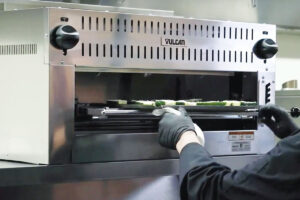
Commercial salamanders are offered in range-mounted, wall-mounted, and countertop configurations, allowing operators to choose based on kitchen layout and workflow needs.
Range-mounted salamanders work best when paired with a range from the same manufacturer, as range risers are specifically designed to support compatible equipment. For new kitchen builds, operators often select the range and salamander together to ensure seamless installation and optimal alignment from the start.
One important safety consideration: never install a salamander above a range equipped with a charbroiler. The intense heat generated by a charbroiler can damage the salamander and significantly shorten its lifespan. Additionally, mounting a salamander in this configuration may obstruct flue ventilation, increasing the risk of smoke buildup in the kitchen. In these cases, wall-mounted salamanders are the safer and more practical choice, especially when mixing equipment brands.
Countertop salamanders, while less common, are an option when sufficient space is available. They are particularly useful for tasks such as plate warming, as their lower placement improves accessibility—especially for shorter kitchen staff.
source: https://www.fermag.com/articles/heat-up-your-kitchen-with-salamanders/