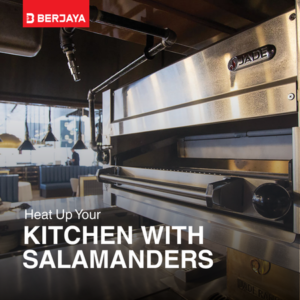
Heat Up Your Kitchen With Salamanders
From dinner service to dessert finishing, a salamander broiler delivers intense direct heat while helping kitchens maximize valuable space.
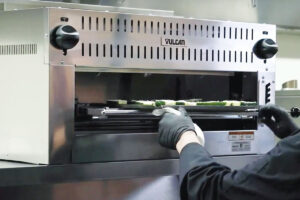
Many commercial kitchens rely on salamander broilers because they offer powerful cooking performance in a compact design. Operators can mount a salamander above a range or attach it to a wall. This setup saves valuable hood space and improves kitchen efficiency.
A salamander is an overfired broiler that uses vertical space instead of additional horizontal cooking areas. By stacking equipment above existing appliances, restaurants can add functionality without expanding their kitchen footprint. This approach can significantly reduce installation costs and maximize available workspace.
Many people confuse salamanders with cheesemelters because they look similar. However, they serve different purposes. A salamander generates extremely high temperatures that allow chefs to broil steaks, burgers, poultry, seafood, vegetables, and other menu items. A cheesemelter operates at lower temperatures and focuses on warming plates, toasting buns, and melting cheese. It cannot cook raw food safely or effectively.
A salamander can perform every task a cheesemelter handles and much more. Chefs often use salamanders to caramelize crème brûlée, brown au gratin dishes, glaze proteins, finish casseroles, and reheat plated meals before serving. A cheesemelter cannot match these high-heat cooking capabilities.
Before selecting equipment, operators should evaluate their menu and production requirements. Some kitchens benefit from a salamander, while others may only need a cheesemelter. Larger operations may even use both pieces of equipment to improve workflow and efficiency.
Salamander vs. Upright Broiler
A salamander shares many similarities with an upright broiler. Both deliver high-heat cooking and finishing performance. However, a salamander features a more compact design and requires less kitchen space.
Kitchen operators should consider expected production volume before making a purchase. A pub or casual restaurant may find that a salamander handles steaks and burgers efficiently. However, a high-volume steakhouse usually requires the greater capacity of an upright broiler.
In some kitchens, a salamander can even replace a charbroiler. This substitution saves space while maintaining cooking flexibility.
E-SALA11 Stainless Steel Electrical Salamander
Heating Methods: Infrared vs. Radiant Salamanders
Manufacturers offer salamander broilers with two primary heating technologies: infrared and radiant.
Infrared salamanders use ceramic heating tiles that emit infrared energy directly onto the food. This technology heats food quickly and efficiently. It works especially well for flat items such as steaks, pork chops, burgers, and similar cuts.
Radiant salamanders use open-flame burners. Stainless steel radiants capture and redirect the heat downward toward the food. This design creates broader heat coverage and produces a more surrounding cooking effect.
Because radiant salamanders distribute heat over a wider area, they perform well when cooking unevenly shaped foods. For example, they can brown half chickens more consistently across different thicknesses.
SALA11N Stainless Steel Electrical Salamander
Infrared Performance and Power Source Options
Many commercial kitchens prefer infrared salamanders because they heat up quickly and reach higher temperatures. Most models achieve operating temperature in about 90 seconds. Faster heating allows kitchens to reduce ticket times and improve service speed.
Infrared units usually cost slightly more than radiant models. In many cases, the price difference is only a few hundred dollars.
Manufacturers offer salamanders in natural gas, liquid propane, and electric configurations. Most operators still choose natural gas because of its availability and lower operating costs.
Interest in electric salamanders continues to grow as more regions adopt kitchen electrification initiatives. However, electric models often cost several thousand dollars more than gas-powered alternatives. While only a limited number of manufacturers currently offer electric salamanders, the market is expected to expand as demand increases.
SALA22N Stainless Steel Electrical Salamander
Salamander Placement Options
Manufacturers offer salamanders in range-mounted, wall-mounted, and countertop configurations. Operators can select the option that best fits their kitchen layout and workflow.
Range-mounted salamanders work best when paired with a compatible range from the same manufacturer. Matching equipment simplifies installation and ensures proper support.
Operators should never install a salamander above a range that includes a charbroiler. The excessive heat can damage the salamander and shorten its lifespan. This placement may also interfere with proper flue ventilation and increase smoke accumulation in the kitchen.
Wall-mounted salamanders provide a safer alternative when kitchens use multiple equipment brands or operate charbroilers nearby.
Countertop salamanders are less common but remain useful in specific applications. Many kitchens use them for plate warming and finishing tasks. Their lower height also improves accessibility for kitchen staff.
source: https://www.fermag.com/articles/heat-up-your-kitchen-with-salamanders/